
-
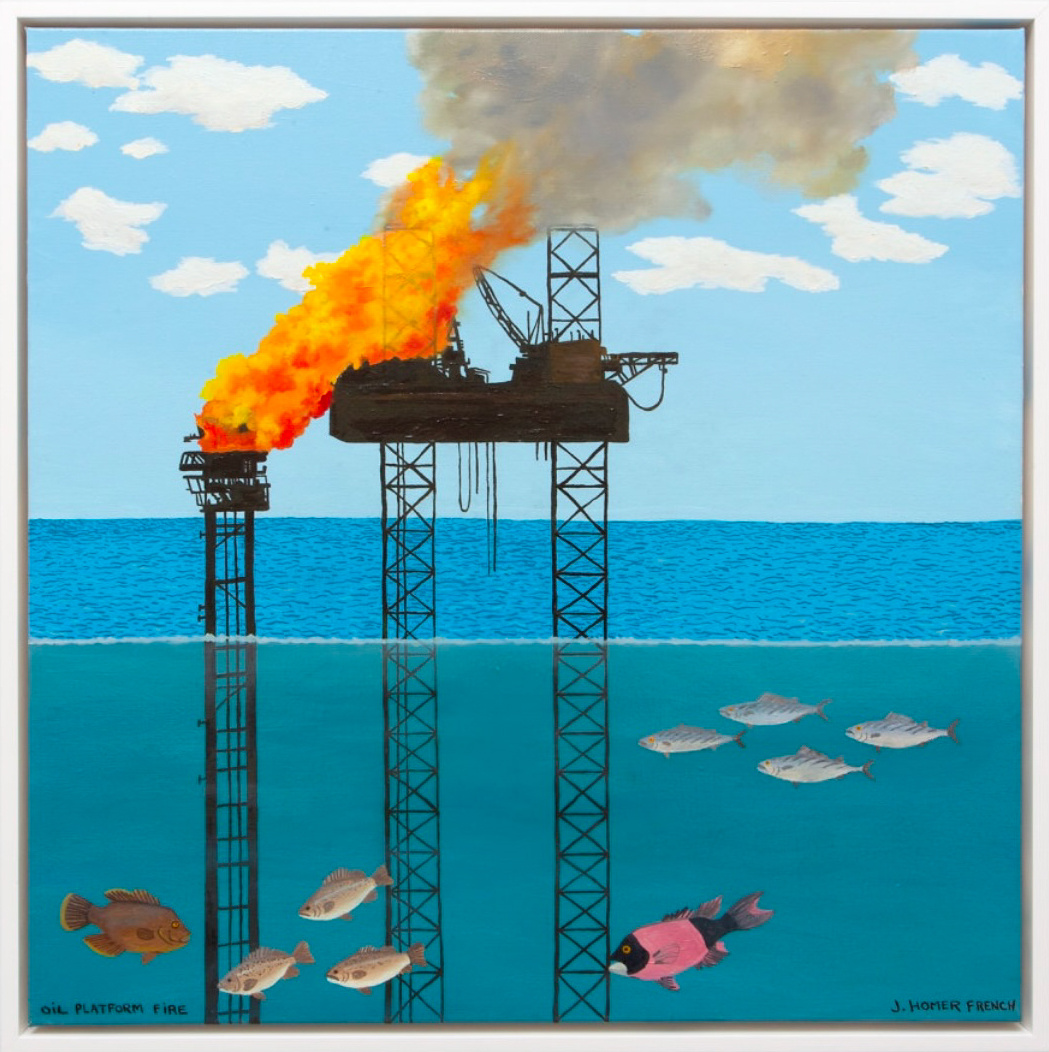
Jessie Homer French, Oil Platform Fire, 2019. Oil on canvas, 24 x 24 inches. Courtesy of the artist.
Intergenerational Feminist Artists Explore Ecological Entwinement and Water Justice
The San José Museum of Art (SJMA) presents a small ocean swallowed, on view from July 10, 2026 through February 14, 2027. This group exhibition brings together six intergenerational and international feminist artists—Sholeh Asgary, Patricia Belli, Kiyo Gutiérrez, Jessie Homer French, Erin Jane Nelson, and Sunaura Taylor— whose work explores how rivers, oceans, aquifers, swamps, and aqueducts shape human and more-than-human life. Coinciding with the opening of a small ocean swallowed, the San José Museum of Art will expand its open hours to the public. Beginning July 14, the Museum will be open Tuesday–Thursday and Saturday–Sunday from 11am–6pm and on Friday from 11am–9pm.
Across performance, sound, sculpture, painting, drawing, and photography, the exhibition considers water as a connective force that links bodies, ecosystems, and histories. The artists engage both the conditions of specific sites and the broader systems water sustains, reframing it not as a passive resource but as an active medium through which life unfolds.
The exhibition is informed by scholar Astrida Neimanis’s concept of hydrofeminism, a theoretical framework for rethinking our relationship to water. It proposes that nothing exists in isolation and that no body—human or otherwise—is ever pure. Every drop is shared, circulating across species, geographies, and histories.
Crucially, hydrofeminism asks us to imagine ourselves as bodies of water. In this view, embodiment is porous and continuously formed through exchanges with other bodies and environments. This shift is not only philosophical but practical, reframing responsibility and care in relation to damaged ecosystems. If we are inseparable from rivers, oceans, and aquifers, their contamination and depletion are conditions we share and are implicated in.
“a small ocean swallowed reflects SJMA’s commitment to exploring urgent environmental questions through contemporary art. The exhibition foregrounds water while addressing ecological degradation and recognizing acts of resistance, repair, and collective care,” said Jeremiah Matthew Davis, SJMA’s Oshman Director and Chief Executive Officer.
The works in a small ocean swallowed take up this call by refiguring the human through forms of representation that render water as a medium of relation, memory, and transformation. In doing so, the exhibition suggests that rethinking the boundaries of the body is essential to imagining how we might repair the waterways that sustain life.
Jessie Homer French, a self-taught painter based in Ojai, California, presents narrative works drawn from direct observation and mediated experience. Her paintings juxtapose natural phenomena such as salmon migrating upstream with human interventions in the landscape, such as offshore oil infrastructure.
Drawings by Berkeley-based artist and scholar Sunaura Taylor give form to aquifers, highlighting underground water systems that remain largely unseen and not fully understood. Her works depict these reservoirs as pressured, anthropomorphized bodies shaped by extraction and contamination. These drawings are in dialogue with her book Disabled Ecologies, which examines environmental disability justice through case studies.
Kiyo Gutierrez, based in Guadalajara, presents performance-based work through video and photography, documenting ritual actions in polluted and rerouted rivers. In boca errante (wandering mouth), Gutierrez uses dyed textiles, gesture, and symbolic knotting to engage rivers as collaborators in processes of mourning and repair. The work references the Pacific Lamprey, imagining acts of return and regeneration.
“Together, these works frame water as a living medium that continuously shapes and reshapes histories, bodies, and environments. Drawing on hydrofeminist thought, the exhibition invites us to imagine ourselves as bodies of water and to consider how we might take responsibility for the systems we inhabit and create more just, livable futures,” said Talia Heiman, SJMA’s associate curator.
a small ocean swallowed is presented in conjunction with the SJMA’s Sowing Sustainability Initiative, a cross-institutional effort grounded in the belief that care for the planet is inseparable from care for audiences, communities, and collections. Through this initiative, SJMA integrates climate-conscious practices across exhibitions, programming, and operations in collaboration with artists, educators, and community partners.
a small ocean swallowed is organized by Talia Heiman, SJMA associate curator.
a small ocean swallowed is made possible by the SJMA Exhibitions Fund.
Operations and programs at the San José Museum of Art are made possible by principal support from SJMA’s Board of Trustees, and a Cultural Affairs Grant from the City of San José and the Skyline Foundation; by lead support from the Lipman Family Foundation, the Adobe Foundation, the William Randolph Hearst Foundation, Toby and Barry Fernald, the Richard A. Karp Charitable Foundation, Tammy and Tom Kiely, Yvonne and Mike Nevens, the David and Lucile Packard Foundation, the Teiger Foundation, the Andy Warhol Foundation for the Visual Arts, and the SJMA Director's Council and Council of 100; and with significant endowment support from the William Randolph Hearst Foundation and the San José Museum of Art Endowment Fund established by the Knight Foundation at the Silicon Valley Community Foundation.
San Jose Museum of Art
The San José Museum of Art (SJMA) is a modern and contemporary art museum dedicated to inclusivity, new thinking, and visionary ideas. Founded in 1969 by artists and community leaders, SJMA’s exhibitions, collection, and programs reflect the defining characteristics of San José and Silicon Valley— from its rich cultural diversity to its innovative spirit. The Museum offers lifelong learning opportunities for schoolchildren and educators, multigenerational families, creative adults, university students and faculty, and community groups. SJMA is committed to being a museum without borders, essential to creative life throughout the diverse communities of San José and beyond.
SJMA is located at 110 South Market Street in downtown San José, California. The Museum is open Thursday 4–9pm; Friday 11am–9pm; and Saturday–Sunday 11am–6pm. Beginning July 14, 2026, the Museum will expand its hours to be open on Tuesday–Thursday and Saturday–Sunday from 11am–6pm and on Friday from 11am–9pm. Admission is $20 for adults, $15 for seniors, and free for members, college students, youth and children ages 17 and under, and school teachers with valid ID. Admission is free from 6–9pm on the first Friday of every month. For up-to-date information, call 408.271.6840 or visit SanJoseMuseumofArt.org.